
Van Rossem about Word Order Change and Audience Design (ROLD, Amsterdam 2015)

On thursday June 11th, 2015 I have presented my paper ‘Numbers to change word order, Philogical aspects of Negerhollands texts to study audience design’ at the Revitalizing Older Linguistic Documentation meeting at the University of Amsterdam. The contents will be published in my dissertation. My PowerPoint can be found here.
ROLD 11 juni 2015 Numbers SHORT DEF

Van Sluijs about change or variation in historical data

In this article, which was already published in December 2014, Robbert van Sluijs focuses on the Virgin Island Dutch Creole imperfective and prospective aspect markers LE and LO. Does the distribution of these markers reflect language change between the eighteenth and twentieth century ? Or is it due to sociolinguistic variation?

Read the article here.

Announcement: Revitalizing Older Linguistic Documentation VI

Workshop VIth International Meeting
of the ACLC Research group
“Revitalising older linguistic documentation” (ROLD)

June 11th, 2015
Bungehuis, room 015, Spuistraat 210
1012 VT Amsterdam, The Netherland


You will find the programme here: programme_workshop_June 11th, 2015

Creole New Testament Moravian Brethren 1802 download and online

The largest  publications in Negerhollands date from the end of the eighteenth (Magens’s New Testament, 1781) and the beginning of the nineteenth century (New Testament of the Moravian Brethren, Barby: 1802, and their translation of Lieberkühn’s Gospel Harmony, New York: 1833). Of two, I already published the links to their digital versions. Hein van der Voort alerted me the 1802 New Testament is also available.

The online version can be visited here.

Gospel Harmony 1833 digitally available

The Creole  version of Lieberkühn’s Gospel Harmony is digitally available here. It was financed by The American Tract Society and was  printed in New York in 1833. The edition of 2000 copies was distributed among the Christianized slaves of the Moravian Brethren on the Danish Antilles. If all copies were distributed, one out of every four to five  above mentioned slaves owned a copy.

The first version was translated by Johann Böhner in or just before 1780 (coded 321). A second version, which had an interesting preface (322), was made only a short period after the first one. The third version (3231) was translated around 1790, probably by Johann Auerbach. About five years later a fourth version was made (3232). Just like 3231, this text is not complete. All manuscript versions can be consulted in the Clarin-NEHOL database.

The manuscripts are obviously written in the same tradition, but differ slightly. Manuscript 3231 seems influenced by the English translation of Lieberkühn’s Gospel Harmony. This can be due to the fact that English became the most important language in the Danish Antilles at that moment.

Manuscript 3232 and the printed version hardly differ. However, since 3232 is not complete, it cannot be the version which was used by the printer.


Psalm-Boek 1774 and 1784

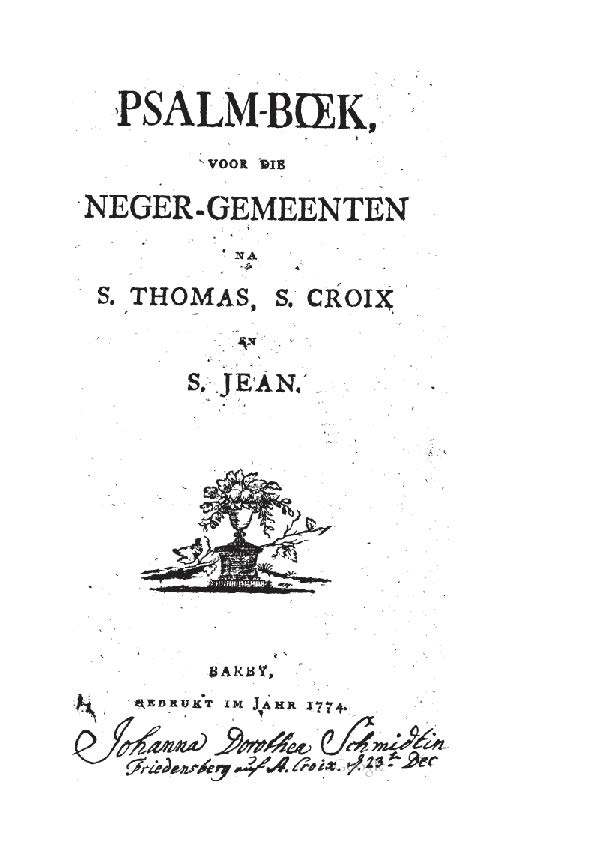
Today I found a scan of the 1774 PSALM-BŒK voor die NEGER-GEMEENTEN na S. THOMAS, S. CROIX en S. JEAN. Barby: 1774. 264 pp.  here. This book of hymns, translated from German into Negerhollands by the Moravian Brethren, can be compared to the 1765 book of hymns which is available as HERRN65a in our Clarin-NEHOL database and the work from 1784

Front page

The scanned work was once owned by Johanna Dorothea Schmidt from Friedensberg, St. Croix. This is interesting to note because of Auerbach’s remark about the use of Creole in St. Croix:

Na St Croex die hab meer van die Negers, die sender kan verstaan English,l as     na St Thomas en St Jan, maar doch, sender <¬English Praat> ka mingel ook altoeveel met die Creol- en Guinee-Taal. Da Neger-English die ben. (March 10, 1774)

“On St. Thomas there are more blacks who can understand English than in St. Thomas and St. John, but still their English speech is mixed very much with the Creole and Guinea languages. It is Negro-English.’ (Van Rossem & Van der Voort 1996: 9)

Also available on the Internet is Psalm-boek voor die tot die Evangelische broeder-Kerk behoorende neger-gemeenten na S. Croix, S. Thomas en S. Jan. Barby: 1784. 322, [46] pp. It can be found here. It is also translated into Creole by the Moravian Brethren and, as can be read in its preface, it can be compared to the above mentioned Psalm-Boek from 1774.

Psalm-boek 1784


Revitalising older linguistic documentation 2015

On June 11th 2015 the VIth meeting of the ACLC Research group “Revitalising older linguistic documentation” (ROLD) will be held at the University of Amsterdam. Participants are kindly asked to send the title of their presentation before April 1st 2015 to one of the organizers Otto Zwartjes ACLC, UvA: O.J.Zwartjes@uva.nl and Astrid Alexander, ACLC, UvA: A.Alexander-Bakkerus@uva.nl. (See: ROLD)


I hope to present my paper Numbers to indicate change of word order in Negerhollands manuscripts. In the eighteenth century Creole manuscripts of the Herrnhuter translators an interesting way of changing word order can be found about fifty times. See the example: volgorde2

The original sentence was

    1. Dan     a          see       Jesus    weer aan         na        sender:
    2. Then   PST     say       Jesus    again               NA      3PL
    3. ‘Then said Jesus again to them:’

According to the number placed above the words, the word order should be changed into:

    1. Dan     Jesus    a          see       weer aan         na        sender:
    2. Then   Jesus    a          say       again               NA      sender
    3. ‘Then Jesus said again to them:’

It is obvious which version was meant by the translator. Undoubtedly the subject of the sentence, should have been placed before the verb to change the original verb second order of Dutch and German into the SVO-order which is obligatory in most Atlantic Creoles, including Negerhollands. The paper, in which all fifty cases will be analysed, will be included in my PhD-research The Negerhollands Textual Heritage: Philological Perspectives on Authenticity and Audience Design.


Cefas van Rossem Languages in Contact, Radboud University Nijmegen

Wuk? West-Vlamsch ip de Moahdeneilanden?

Robbert van Sluijs talks on Belgian Radio 1 about West Flemish influence on Dutch Creole  In Dutch. Please listen to it here!

Introductory article on ‘Stemmen van Afrika’ (Voices of Africa website)

This morning, an introductory article on Negerhollands by Robbert van Sluijs was published (in Dutch) on the Dutch website Stemmen van Afrika (Voices of Africa). It is a popular scientific website devoted to showing you the languages of Africa in words, images, and sound.

Here is a direct link to the article.

Please have a look even if you don’t understand Dutch for the pictures and the two sound files  of the last speaker, Ms. Stevens (recordings by Robin Sabino).

Powerpoint Van Rossem SCL/SPCL Aruba

Alternative words: service or red herring, Philological approach of 18th century Negerhollands

10525912_885513548144570_2727615984431703050_n

You will find the powerpoint presentation of the paper I presented on the SCL/SPCL conference in Aruba, August 6th 2014, here: SCLSPCL_AlternativeWords_Service_or_Red_Herring