
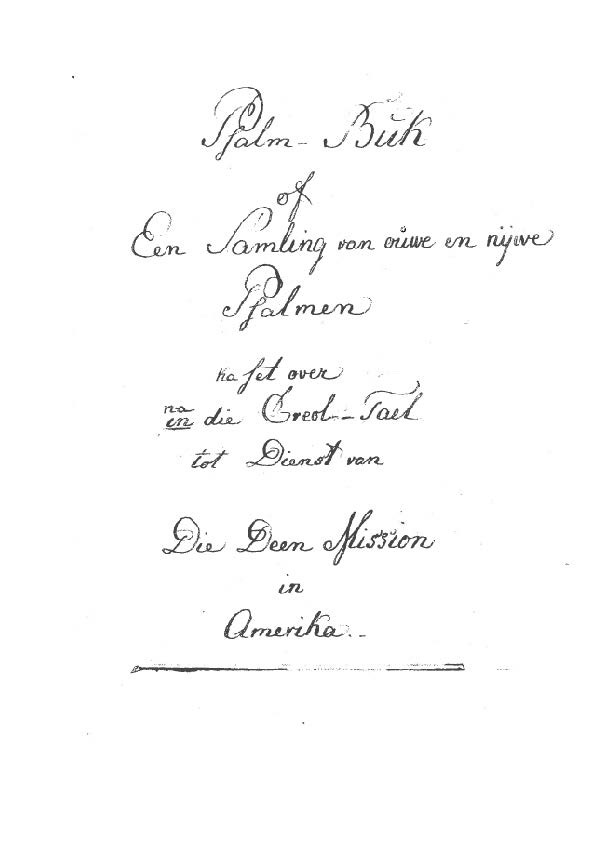
In a letter from 1773 we find the first clue that Johann Böhner had at least started to translate Samuel Lieberkühn’s Gospel Harmony (1768) into Virgin Islands Dutch Creole. In the following years he made at least two versions before 1780 (manuscripts 321 and 322). During a conference in 1784 it was decided that J.C. Auerbach should make another version for a better connection to the audience of (enslaved) inhabitants of the Danish Antilles. We think the unfinished manuscript 3231 is from his hand. A final manuscript version, from before 1795, is also incorporated in our corpus.
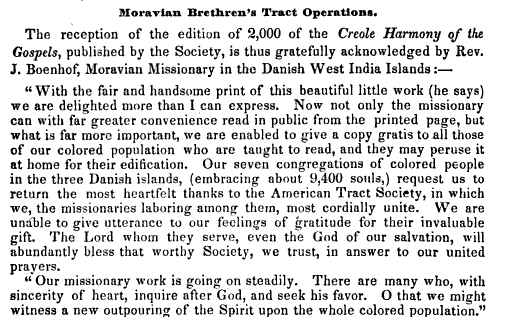
In 1833 Die Geskiednis van ons Heere en Heiland Jesus Christus, soo as die vier Evangelist sender ka skriev die op is published in New York, financed by the American Tract Society. 2000 copies were distributed among 9400 Christianized slaves (Anon. 1836), so of lots of people it must have thought they had the skill to read Creole. Still it was the last printed Virgin Islands Dutch Creole text of the Moravian Brethren.
The content of the manuscripts is available in the digital Clarin-Nehol Corpus. On the Scanned Publications page, you will find the scanned version of this 1833 Virgin Islands Dutch Creole Gospel Harmony.


Dutch as a koine?
Aarhus Danish Atlantic 160116 Dutch as a Koine
On January 16, 2016, I presented this paper in Aarhus at the symposium The Danish Atlantic (Aarhus University). Next to papers in the field of history, anthropology, archives and museums, five had a linguistic subject. Robbert van Sluijs (Radboud University) about West-African grammatical influence on VIDC, Peter Bakker (Aarhus University) about Danish linguistic elements in West-African and Dutch Creole languages, Kristoffer Boegh (Aarhus University) about the differences between Dutch Creole lects and other Creole languages and Peter Stein (several universities, Emeritus) about Oldendorps reports on the life of enslaved people.
The Dutch language was the largest lexifier of VIDC, and to be be more precize: the influence of Western Flemish and Zeelandic dialects is obvious. However, we do not know exactly how these elements entered into the vernacular of the Danish Antilles. I already presented on this subject in Brussels (2012), which was published in Revue Belge, but in this presentation I focus on the exact variant of Dutch and not only on demographic information.
Further reading? This will be a part of my dissertation. Please feel free to send me an email about this subject.
Cefas van Rossem
Leave a comment
Posted in Danish sources, Historical corpora, Manuscripts, metalinguistic comments, Presentations, Uncategorized
Tagged Demography, eighteenth century, koine