In 1739, during the visit of the Count Nicolaus von Zinzendorff, two letters were written by enslaved members of the community of the Moravian Brethren. In the first letter, which was addressed to the Danish king, a group of enslaved people complained about their position in the Christian community. Despite being baptized, they were looked down upon by the colonists.
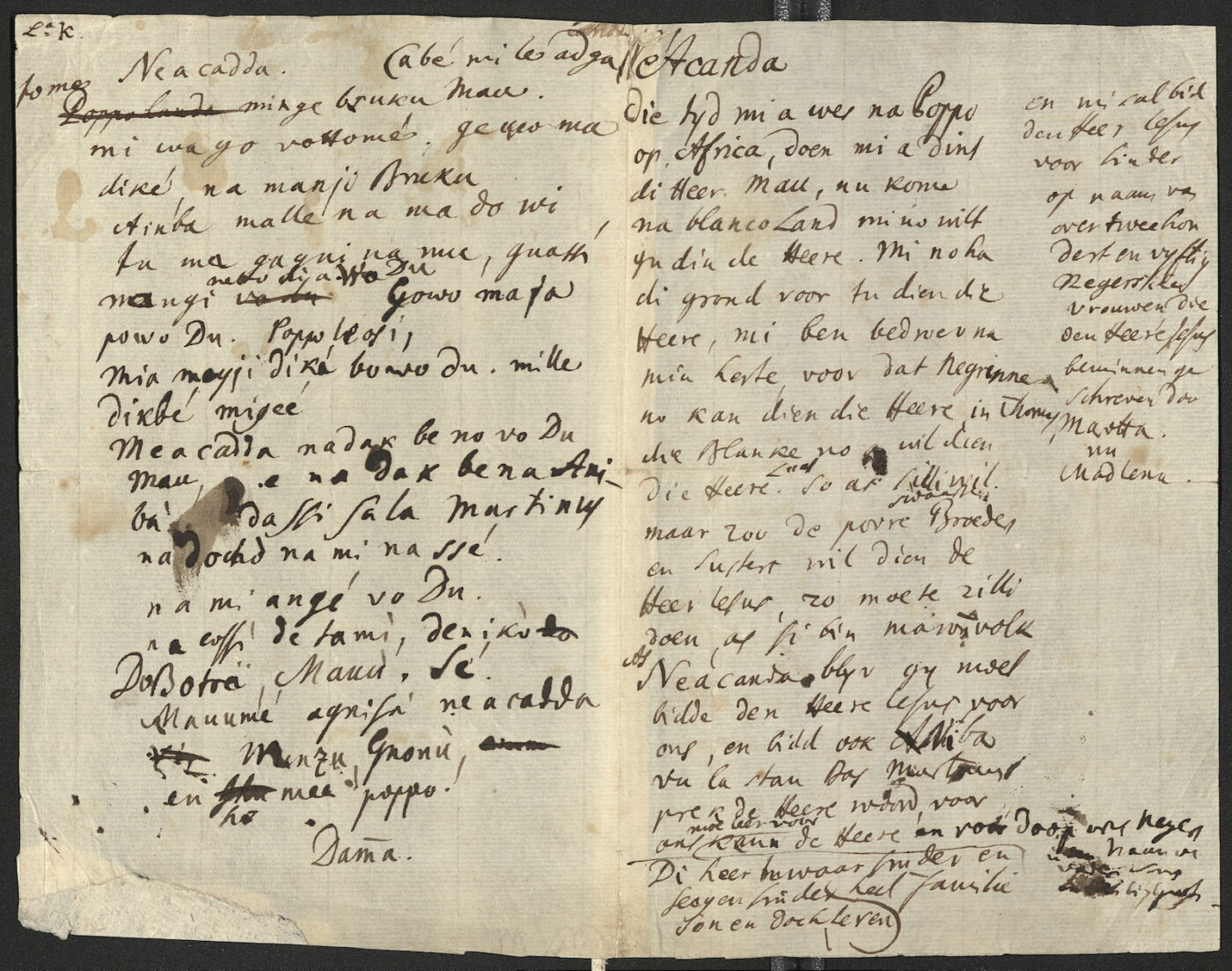
The second letter was written by Damma, also known as Marotta and Madlena. It consisted of two texts: one of them was written in an African language that was unknown to us until recently and the other was a translation of it into Virgin Islands Dutch Creole. In 1742 these letters were published and these were probably the first examples of texts in which enslaved people expressed their emotions in non-European languages.
The African letter of Damma remained a mystery and several scholars tried to unravel parts and pieces, using the Creole translation. Indications of possible West African languages were presented and published,but unfortunately, an undisputed language variant was lacking.
Version 1 of Damma’s letter. Courtesy of the Unitätsarchiv der Evangelischen Brüder-Unität, R.15.B.a.03.61_a-b
Two years ago Katharine Gerbner, assistent professor History of Religion at the University of Minnesota, formed a research group in which she, five linguists specialized in West African languages and Virgin Islands Dutch Creole and a historian specialized in the history of female enslaved in the Danish Westindies, worked together to translate the text, but also to portrait the writer of it.
The website which was constructed looks beautiful and consists of several related essays. The African letter is translated and Damma turned into a real person.
In a St. Thomas catechism manuscript from the period 1842-1847, pastor H. Wied has written on the title page ‘In the 1840s, the Creole language disappeared in the West Indian islands and was replaced by English.’ But that didn’t happen. In 1871 and 188/1887, publications by the American scholar Addison Van Name and the Danish physician Erik Pontoppidan were published, still containing some remnants of Virgin Islands Dutch Creole, or Carriols as we call the language nowadays.
In 1883, the Austrian Hugo Schuchardt, perhaps the first linguist we can call a creolist, received a letter from the Virgin Islands physician Anthon Magens. It was a response to a request for a fragment in the Dutch Creole as spoken by the population of St. Thomas. Only in 1914 this letter, filled with words unknown from eighteenth-century sources, was published in the Tijdschrift voor Nederlandsche Taal- en Letterkunde. On May 28, 2022, I published an episode about this letter, ‘The Letter of Anthon Magens’ in my podcast Di hou creol. (10. De brief van Anthon Magens)
The letter that Schuchardt received from Magens in 1883 turned out to be the first comprehensive account of the Dutch Creole as spoken by the local population of the Danish Antilles, St. Thomas, St. John, and St. Croix.
Carriols as sources dating back to shortly after the language’s emergence. In 1672, the language did not yet exist, it is first referred to in 1736, and since 1739, there have been written texts in this language. However, the vast majority of these texts consisted of translations of missionary texts by German and Danish missionaries. In my research from 2017, I attempted to find clues about the actually spoken Creole in these texts.
Anthon Magens, a distant relative of Jochum Melchior Magens, who published a grammar of the Virgin Islands Dutch Creole in 1770, stated in a letter to Schuchardt that he recorded the daily language with the help of his maid. After a description of a day in the Creole, with many words for vegetables for example and a series of proverbs, follows a so-called ‘pistarkel’, a spectacle that the doctor would have experienced in the streets of Charlotte Amalia. Schuchardt’s publication is in German, but the Creole has been translated into Dutch by Dirk Christiaan Hesseling, who dedicated a substantial publication to the language in 1905.
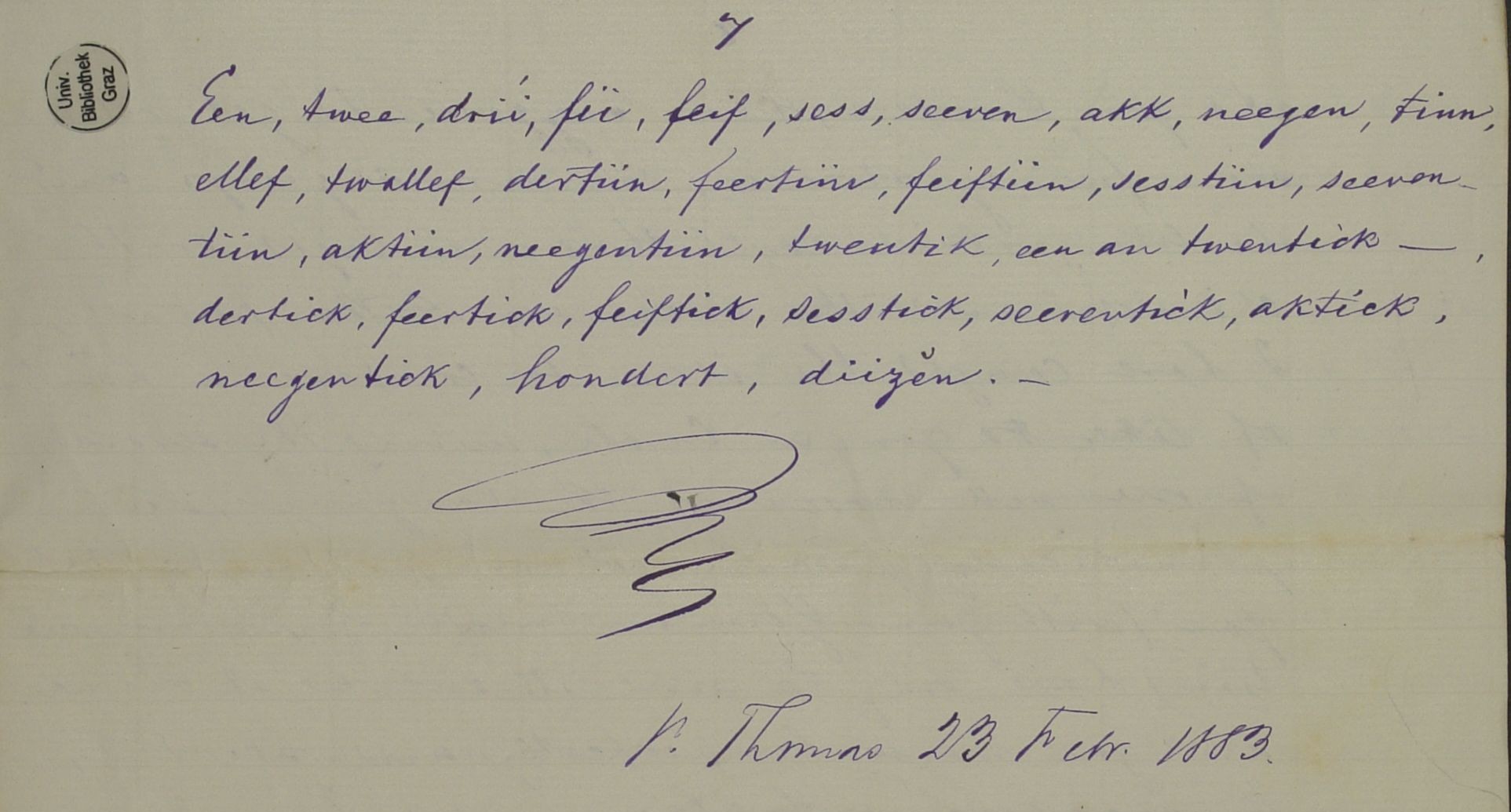
The complete letter is preserved in the archive of Hugo Schuchardt in Graz, and for instance, Peter Bakker, who is currently leading a significant research group on the Virgin Islands Dutch Creole in Aarhus, and his student Sebastian Dyhr, had studied the letter some years ago. Through Sarah Melker, the archivist of Schuchardt’s archive, I received photos of the letter. There is hardly any difference between the letter and its publication in 1914, except for one part on page 7: the numerals.
Why wasn’t this part of the letter published by Schuchardt? Didn’t he consider it of importance? I think it is a valuable addition to the rest of the Creole texts.
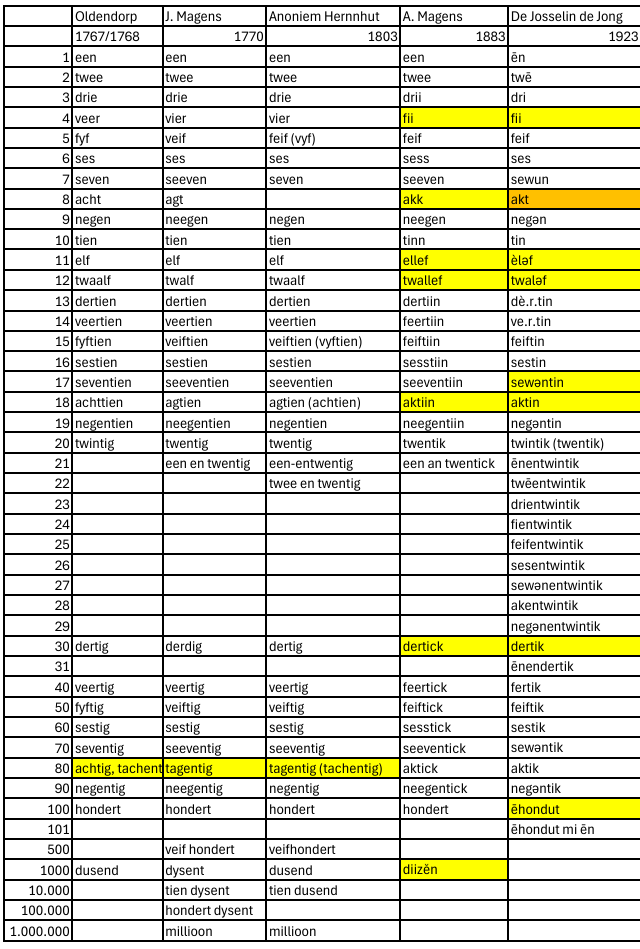
Already in 1767/1768 Oldendorp published numerals in his dictionary (Stein 1996). In Magens’s 1770 Grammar the list is even longer and an anonymous Moravian Grammar copied Magens’s list with some changes. These list were probably necessary for the translations of the missionary texts and look quite Dutchlike.
The numerals as used in the wordlists and texts by De Josselin de Jong (1926), Nelson (1936) and Sabino (2012) look not as bookish as the above mentioned. Of course these were collected during field work in conversations. It is nice to see the numerals from the Magens-letter do show not only Dutchlike numerals, but also the more Creolelike ones which are similar to those which were collected by De Josselin de Jong, Nelson and Sabino.
In this figure you will find all numerals from the above mentioned publications. De Josselin de Jong (1926) mentions his informants, however it is unclear who submitted these numerals and whether these were from St. Thomas or St. John. Nelson (1936) collected two sets of numerals, by Henrietta Francis (Fredriksted, St. Croix) and Rebecca Francis (St. Thomas). Robin Sabino learned the language from Alice Stevens in the 1980s. I used her dictionary from Sabino (2012).
The yellow words are remarkable. See for instance the words for 80. In 1767/68 both achtig en tachentig are used. Tachtig is as in Dutch tachtig,of which the t may be explained from Old Saxon antathoda. In the words for 80 which were recorded during fieldwork, no initial /t/ is found.
We can also see the final /g/ changes during time into /k/ (achtig (80) -> aktik) or it disappears, like in other numerals: dertig (30) -> dertik -> derti).
Henrietta Francis (St. Croix, 1936) used some forms which point to a a kind of twenty-based system, in which the word enskeling is used for 20, twe skeling for 40, dri skeling for 60 and forskeling for 80. In historical Dutch schelling indicates a 20th part of a pound (see Woordenboek der Nederlandse Taal). The word en patakon, she used for 100 is also interesting. It was used in historical Dutch, but is etymologically related to Iberian languages.
I haven’t checked the use of numerals in the eighteenth century missionary texts, like the Old Testament or the Gospel Harmonies yet. However, it is already clear that the list from the Magens-letter is an interesting link between written Carriols of the eighteenth century and the spoken variety of the twentieth century.
Only a few days ago editors Kristoffer Friis Boegh (University of Utrecht, the Netherlands, University of Aarhus, Danmark) and Peter Bakker (University of Aarhus) published the special issue of Scandinavian Studies in Language: Vol. 15 No. 2 (2024): Special issue: Pidgins, creoles, and language contact in Danish and Dutch colonial contexts.
No less than five articles are dedicated to aspects of Virgin Islands Dutch Creole, its history and metalinguistic matters:
Yesterday evening, Gylchris Sprauve, Peter Stein and I were discussing the contents of a book about Virgin Islands Dutch Creole during our weekly ZOOM meeting. Among these people, including Gilbert Sprauve who is also almost always present during these meetings, it is hard to stay focused on the matter; we tend to discuss all kinds of aspects of the language Virgin Islands Dutch Creole, special sources, its history and all related researchers.
When I showed Peter Stein and Gylchris Sprauve the use of the Dutch Delpherwebsite, in which a bulk of books, magazines, journals et cetera from the seventeenth century until present can be searched, I thought the name Sprauve would be a nice entrance to search for.
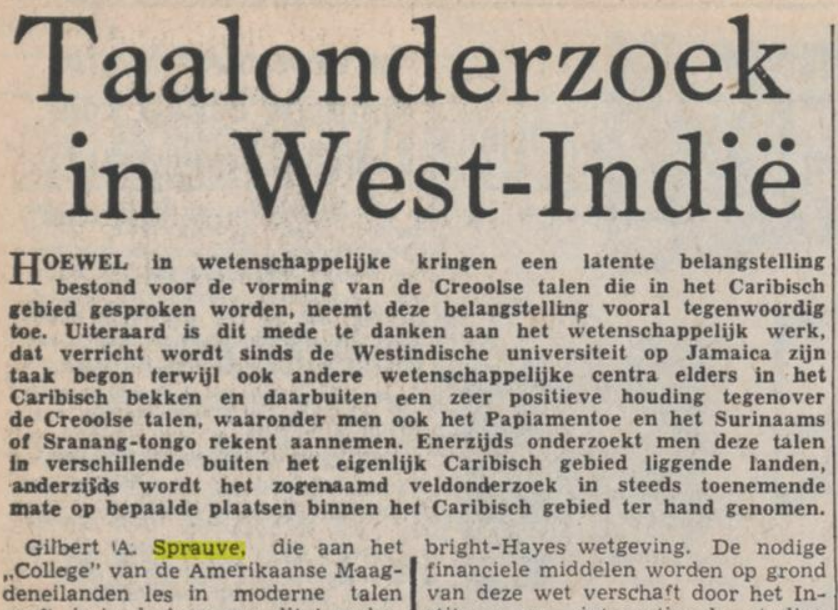
The name Sprauve only appears a few times in Dutch related newspapers. IIn a few cases it refers to the last name of weightlifter Liston Sprauve who became twelfth in the 1968 Olympic Games in Mexico. However, suprise struck us, when we saw the Curaçao newspaper Amigoe dedicated an article to the research by Gilbert Sprauve, whom we know as the one who found out Virgin Islands Dutch Creole was still spoken in the 1960s.
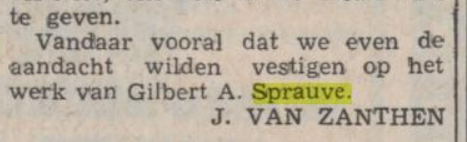
In his article Taalonderzoek in West-Indië (‘Language research in the West Indies’, November 15, 1968) J. van Zanthen presents Gilbert Sprauve, who was working in the College of the US Virgin Islands and his linguistic research on the Creole languages of St. Lucia and Dominica. He writes the study will last for a year and will be financed by Fulbright-Hayes. Sprauve will focus on the pronunciation of the languages and the composition of them. Next to that Van Zanthen presents a short overview of Sprauve’s study and his day to day job in the College of the US Virgin Islands: education of modern languages (French and Spanish, as I know now).
The most important aspect of this article is probably that someone from the West Indies is going to study Caribbean Creole languages. It is compared to the situation of Papiamentu and Sranan on which also linguists from respectively the Antilles and Surinam worked. In the case of Sranan, dr. (Hein) Eersel is mentioned. He was my teacher in the Dutch department of the Institute for the Education of Teachers (I.O.L., Paramaribo, Surinam) which I attended in 1984-1985, and who recently passed away shortly after his 100th birthday.
During our ZOOM meetings Gilbert Sprauve refered to this research on Creole languages in Guinea and Sierra Leone, but also St. Lucia and Dominica a few times, not only because of the Creole language, but because the beautiful encounter shortly after his return. His research has been noted in the Daily News in St. Thomas, and when he was walking through the main street of Cruz Bay, St. John, a voice shouted at him in a language he did not understand. It became the start of the study of living Virgin Islands Dutch Creole, by Gilbert Sprauve, Anne Adams and Robin Sabino, and their students.
The entire story will appear in the above mentioned book!
‘That is why we wanted to draw attention to the work of Gilbert A. Sprauve.’
Only a few weeks ago Peter Bakker (Aarhus University) informed me that Poul Olsen (Rigsarkivet, Copenhagen) found a Dutch Creole sentence in a police report. He published it as a reply to the Lingoblog article from January 2024 about the six newly found Berbice Dutch Creole sentences.
His reply, in Danish, is the following. The Dutch Creole sentence is made bold by me:
Poul Erik Olsen, 21 June 2024
Mægler Kreutzfeldts gengivelse af kreolsk: Rigsarkivet, København: St. Thomas byfoged. Sager til bytingsprotokoller 1790-1795. [8/340] J.H. Kreutzfeldt til politimester Stenersen, St. Thomas, 1. oktober 1790: Ifølge Deres Velbyrdigheds Forlangende er min efterskrevne Erklæring alt hvad mig er vidende om den udi Fortet arresterede Neger Phelix. Ved under den 12 September om Formiddagen imellem 12 og 1 at gaae need ad Byen, mødte mig frie Vagten med en Spansk Neger kaldende sig Juan Melise og da de kom ved Hercules Hassells Huus, kom ommeldte Neger Phelix dem i møde og betegnede da denne Juan Melise at det var Manden, hvorpaa Vagten gik med Neger Phelix ned ad Byen; Strax derpaa observerede at en Neger tilhørende Hr. Souffrain kom trekkendes med en Oxe ud af Hr. Hassells Plads, og dertil brugte disse Udtryk udi Creolsk (Ha, ha, tender ka thief you, men mi nu ka Krigh you Kanaille) disse Ord giorde mig Opmærksom, og gik derpaa hen og spurgte, hvad det var, hvorpaa der mig af en Barbarie blev svared at det var en Oxe som af en Neger, som Vagten gik med, havde stiaalet fra Hr. Souffrain og solgt til ham, og nu toeg Hr. Souffrain sin Oxe igien, hvorpaa jeg svarede at det ey kunde lade sig giøre, men at Oxen maatte forblive paa det forefundne Stæd indtil der var skeed Anmeldelse hos Hr. Byfogden, som da og skeede, derpaa forføyede mig need ad Byen, søgte PolitieBetienterne , men fant ingen, hvorpaa gik hen til Capt. Peter Tameryn, hvor Vagten var med forbemeldte Neger Phelix, jeg spurgte Capt. Tameryn, hvorfor han opholde og ey sendte denne Neger til Fortet, han svarede, at da Phelix havde declareret at Emanuel tilhørende Enken Madame Schwartzkopff var den der havde leveret ham Oxen, havde han sendt for Emanuel for der paa Stædet at examinere dem; Jeg sagde ham at her var ey Stædet til Examination, men at Hr. Byfgogden var ikkuns den, som dertil var berettiget, og at han kuns giorde best i at lade Negeren Phelix i fortet arrestere, hvilket han da og ordinerede sin Vagt til, jeg spurgte derpaa denne Neger Phelix hvorledes han var kommen til Oxen, han svarede mig , at Emanuel var komme og havde vogned ham ud af Søvn og sagt ham at han havde bragt en Oxe for ham fra Porto Rico, Jeg spurgte ham derefter om han ey vidste at Emanuel var en Slave og ey farede paa Porto Rico, det første besvarede ham med Ja! Men det sidste med Nei! Men at Emanuel daglig var vandt til at fahre, og blev bestandig ved at raabe paa Emanuel, ieg spurgte ham om den omtalte Neger Juan Mellise eller andre ey var med videre udi denne Sag som med Nei! aldeles besvarede, men at Emanuel, Emanuel, det var hans Mand; det haver nu viidere ligeledes hørt af Enken Madame Schmidts Negre at være blevet bekræftet, at virkeligen Emanuel er kommen og haver banket paa Porten for at opvogne Negeren Phelix, efter at han havde transporteret Oxen udi Savannen bag ved Hr. Friborgs Huus, og at Negeren Phelix have derpaa gaaet need ad Byen og siden kommen og med forhen meldte Barbarie som da og kiøbte bemeldte Oxe, hvorvel det var Nat og som da meget vel burde have vist at det var stiaalet Gods. St. Thomas, 1 October 1790 Ærbødigst J.H. Kreutzfeldt
This is a great find. The early sources of Virgin Islands Dutch Creole are mainly missionary texts by German or Danish translators and we only know a handful of texts which have a secular character. See for instance the following article in which seven newly found texts from the end of the eighteenth and the beginning of the nineteenth century.
Bøegh, Kristoffer Friis, Peter Bakker, Cefas van Rossem & Rasmus Christensen. 2023. “Seven newly discovered 18th and 19th century Virgin Islands Dutch Creole Texts”, in: Faraclas, N., R. Severing, E. Echteld, S. Delgado & W. Rutgers (eds) Caribbean Convivialities and Caribbean Sciences: Inclusive Approaches tot he Study of the Languages, Literatures and Cultures of the Dutch Caribbean and Beyond. Willemstad: University of Curaçao. pp. 93-116.
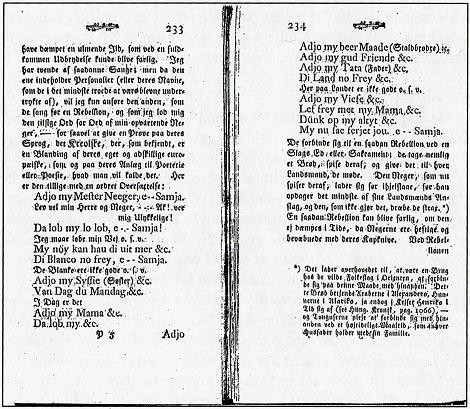
The most intersting one is probably the E-Samja farewell song from 1788 (Van Rossem & Van der Voort 1996: 224-226).
The Danish part of Kreutzfeldt’s report was only accessible for me with the help of Google Translate. The Creole sentence however, is clear and immediately gives context to the story of the stolen ox:
/ : ha, ha sender ka Thief you, men nu mi ka Krigh you Kanaille : /
Ha ha, 3PL PERF rob 2SG, but now 1SG PERF get 2SG, villain/rascal
‘Ha ha They have robbed you, but now I have got you, villain!’
Peter Bakker and Kristoffer Bøegh presented quite interesting information which clarifies the sentence, but also places it in its context. The spelling of Thief (instead of dief ‘to steal, to rob’) and you (instead of joe ‘you’) point to English as the language in which these words from Creole can be represented best. Peter Bakker mentioned that the use of Krigh (Dutch krijgen ‘to get’) instead of kri, which is the common pronunciation in the twentieth century, indicates the consonant at the end of the word was still in use. The use of men is somewhat unclear. I thought it to be a assimilation of manu (Dutch maar ‘but’ nu ‘now’) into men. My colleagues from Aarhus think that the use of Danish men ‘but’ is more obvious.
In Van Rossem & Van der Voort (1996: 227-229) some similar sentences from police reports are published, which were by the way found by Hein van der Voort and Poul Olsen. Although not dated in Die Creol Taal, I know from the photo copies they must have been found in the early nineteenth century reports.
Poul Olsen found this sentence like a needle in a haystack. There are hundreds, perhaps thousands of pages of Police and other reports in the online archives of the Danish Westindies. Hopefully, many interested ones will also try to find some Creole sentences, for instance here.
In the Unitätsarchiv in Herrnhut, Germany, an interesting manuscript of an early grammar of Virgin Islands Dutch Creole is archived. It was never published, but large parts of are probably borrowed from the language description by Oldendorp (1770) and Magens’s Grammar (1770). On the other hand this text also contains original observations which are illustrated by examples from missionary texts from the end of the eighteenth century.
D.C. Hesseling, the author, was aware of the existence of the above mentioned manuscript. For his work Het Negerhollands der Deense Antillen (1905) he ordered a copy. Several letters between Hesseling and the head of the archive in Herrnhut, Glitsch, about making this copy, are still stored in the library of Leyden University.
Hesseling mentions this grammar quite often in his 1905 work, but the copy could not be traced among the manuscripts in Leyden University. Luckily, Hein van der Voort and I found it among printed works.
The original manuscript (about which an early post was written) is hard to read because of the state of the material and the so-called German Kurrent Schrift, which differs a lot from Roman font. Hesseling’s 1903 copy was not only easier to read for me, but also for the outstanding transcription program Transkribus. From October 2023 and this moment, Transkribus composed the first draft (and believe me, a human interface was quite necessary) and was corrected by me.
I already started adding foot notes and other comments to this translations and I am looking forward to publishing the entire text in near future!
An example from p.94-95:
Bei der Ueberset-
zung mancher Stellen der heiligen Schrift und geistlichen
Liedern zeigt es sich noch bisweilen, daß Worte dazu fehlen.
Will man in solchen Fällen Worte aus der holländischen
oder deutschen Sprache nehmen und sie nach der Aehnlichkeit
der Creolischen Art einrichten oder verwandeln, so ist doch
große Behutsamkeit und eine gute Wissenschaft der hol-
ländischen Sprache nötig: damit man nicht nach der Aehn-
lichkeit andere Wörter welche mache, die deswegen im hol-
ländischen nicht immer heißen, was sie heißen sollen, son-
dern oft viel was anders bedeuten.
Grammatik der Creol-Sprache in West-Indien. 1903. 112 pp., small 4°, Herrnhut. {P}
>UBL 163 C 33 (formerly 559 H 28).
>Hesseling (1905) writes that he obtained a copy of the original manuscript from 1802 with the same title from mr. A. Glitsch in Herrnhut. This manuscript/copy (from the beginning of this century) cannot not be found in the Hesseling archive in the library of the Leyden University nor in the manuscript collection, but in the collection of printed works. On the inside cover is written that it is a gift from 1941 by Hesseling’s widow A. H. Hesseling-Salverda de Grave. The back of the cover bears the title `Het Negerhollands der Deense Antillen’.
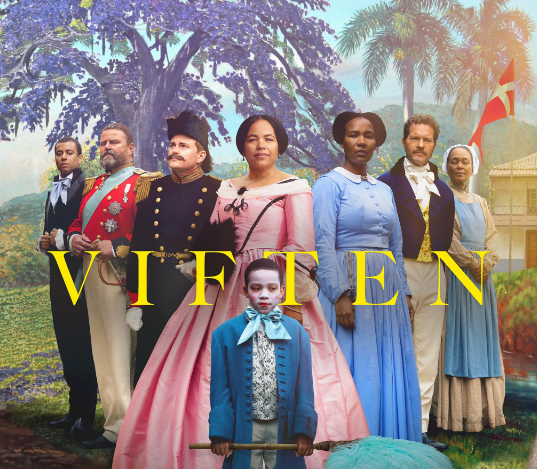
On August 23rd I mentioned the Danish film Empire (Danish: Viften)was nominated for the Nordic council film prize. Today Kristoffer Riis Boegh emailed me to tell Empire actually won the prize!
Today Berthold van Maris published an article in NRC, an important Dutch newspaper, about the six sentences and including a picture of Virgin Islands Dutch Creole runaway ad. You can find the article, in Dutch, here:
Although the focus of the article is not on Virgin Islands Dutch Creole, I think it quite nice to see which discoveries were made in related Dutch Creole texts in the Caribbean. The following article (in Dutch) was published on the website Neerlandistiek.nl October 24, 2023. During the following day, Peter Bakker and Bart Jacobs have send several comments of which at least one should be included to complete the texts!
Een donders comike taal. Six sentences Berbice Dutch Creole from 1803 (updated version)
Only recently archive researcher Mark Ponte send me a link to a scanned letter from the Dutch National Archives. He assumed I probably already knew these sentenses. However: not so!
The letter was written on March 7, 1803, from Rio Berbice (in nowadays Guyana) by the Dutchman G.H. van Langen. In the letter it comes clear that he is from the Dutch town of Dordrecht. The addressee is his aunt Elisabeth de Loos, also from Dordrecht. The letter consists of three pages in which Van Langen writes about his ups and downs in the colony, about sending a monkey to his uncle in the Netherlands, and he also asks whether his aunt prefers a blue or a red parrot to be sent to her. My attentention was drawn to the following comment on the second page of the letter:
het is hier een donderse comike taal. de duivel magt dat volk verstaan. ik zal u van onderen in mijn brief een paar Reegeltjes Criools schrijven, dan zult UEd eens zien hoe een verdomde Taal het is, nog veel slimmer als hebreeuws of joods
Free translation: Here is a very comical language. The devil may understand that people. I will write some lines of Creole at the end of this letter. Then you will see what a damn language it is, even more difficult than Hebrew or Jewish.’
I really enjoy this kind of metalinguistic comments. Apparently the language sounds funny to him, but he also thinks the language is more difficult than Hebrew or Jewish.
In this quote we also see the oldest find of the word ‘Creole’ when it comes to Berbice Dutch Creole. In the oldest source of this language, a glossary in a travel report from 1794, Peter Constantijn Groen talks about ‘Berbician words’. It was published by Ian Robertson in 1994.
As promised, Van Langen presents some, six, sentences in the last paragraph of the letter, accompanied by the Dutch translations. With the help of three word lists (Kouwenberg 1994, Robertson 1989 and Robertson 1994) I was able to decipher the sentences and compare them to the translations by Van Langen himself.
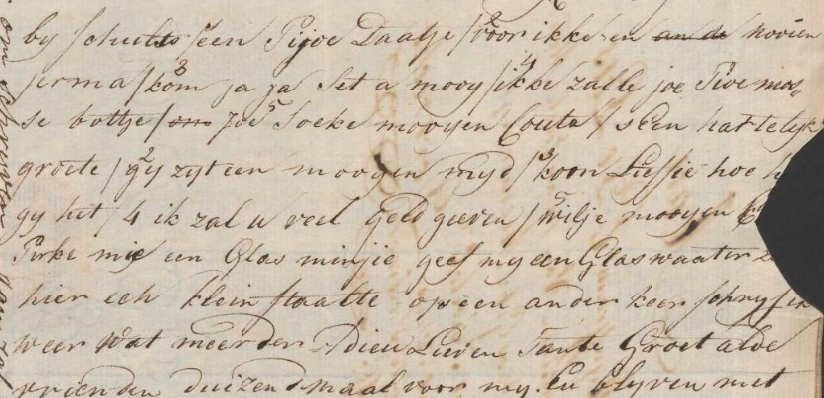
Facsimile of the six Berbice Dutch Creole sentences (Van Langen 1803: 3)
1.
Van Langen, Creole: Een Pijve Daatje
Van Langen, Dutch: Een hartelijk groete (lit. ‘a heartly greeting’, ‘kind regards’)
Van Langen, Dutch: gij zijt een mooijen mijd (lit. ‘you are a beautiful girl’)
Kouwenberg: fu eke en moi jerma
gloss: for me a beautiful woman
3
Van Langen, Creole: Kom ja ja set a mooij
Van Langen, Dutch: kom Lieffie hoe h*…* gij het (lit. ‘Come, sweetie, how do you *have* it’)
Kouwenberg: kumu ? sete moi
gloss: come maid stay beautiful/good
4
Van Langen, Creole: Ikke zalle joe pioe m*o*sse bottje
Van Langen, Dutch: Ik zal u veel geld geeven (lit. ‘I will give you a lot of money’)
Kouwenberg: eke sa ju pi+ju musu boki
Gloss: I will you give+you much money
5
Van Langen, Creole: Joe soeke mooijen Couta
Van Langen, Dutch: wil je mooijen C*i…* (lit. ‘You want beautiful c*…*’)
Kouwenberg: Ju suku moi kuta
Gloss: you search beautiful beads/bead necklace
(6)
Van Langen, Creole: Pirke m[ij]<+ie> een Glas minjie
Van Langen, Dutch: Geef mij een Glas waater z*…* (lit. ‘Give me a glass of water z*…*.’)
Kouwenberg: Pi+eke mi en glasi minggi
Gloss: give+I me a glass water
The common words jerma ‘woman’ and minjie ‘water’ can be seen as a shiboleth to know this text is in Berbice Dutch Creole. These, but also some of the other words are unmistakenly derived from Easter Ijo, a language spoken in Nigeria’s Kalabari region in the delta of the Niger river. These words are not found in any other Caribbean language. Many, if not all, Caribbean Creole languages emerged from contact between European and African languages, however none of them shows so many words which originate from only one African language (Smith, Robertson, Williamson 1987).
Remarkable in sentence 5 is the word Couta, which appears as kuta ‘bead, bead necklace’ in Kouwenberg (1994: 633). It is also from Eastern Ijo. The use of it in this text immediately reminded me of the oldest text in Skepi Dutch Creole (Van der Wal 2013):
en sok kum kloeke dagka van noom die sitte bi warme lantta
‘And when the big day comes for the uncle who lives in the warm land’
En als um kom weeran bi Bikkelante
‘and when he comes again in the Netherlands (the big country?)’
Hom sel brengk van die 4 blabba moye goeto
‘he will bring for the four children beautiful goods’
Immediately afther this Skepi sentence in the letter in question, the writer provides the following metalinguistic comment:
is dit geen moye taal? Dog als UEd’ er niet uyt kan komen d’Heer Schalkwyk die hier in ’t land geweest is, zal zulks wel vertolken.
‘Isn’t this a beautiful language? However when you cannot understand it, mister Schalkwijk, who has been in the country, will translate it well.’
This Skepi sentence is therefore not an isolated ‘joke’, but a fragment of a language that could be spoken by at least one person in The Netherlands. Just like Berbice Dutch Creole was spoken alongside the Berbice and the Wiruni, Skepi (>Isekepi, Essequibo) was known in settlements along the Essequibo. I can hardly imagine that more family members of planters did not receive letters with similar language fragments.
The word goeto ‘good’ appears in the nineteenth-century description of the Skepi Dutch Creole by the English missionary Youd (1837, Jacobs & Parkvall 2020). But, could this perhaps also mean couta, kuta ‘string of beads’? The origin of the word blabba ‘child’ has not yet been found. However, according to Youd, kente is the word for ‘child’. Some colleagues thought of babbelaar ‘chatterbox’ as the origin, which I think is quite possible. In the Youd material by Jacobs and Parkvall (2020) I did find cabba ‘good friend’ and labba ‘agouti’, Sranan ‘kon’koni’, a rodent that is also referred to as rabbit in Surinamese Dutch. Could blabba be a related pet name?
In the available word lists of Berbice Dutch Creole I did not find the translation of ja ja (sentence 3) and at first I thought that it might mean ‘here’ (dja>En here), much like in English-related languages such as Sranan. The word in Kouwenberg (1994) which comes closest to ja ja with the meaning ‘sweetie’ is perhaps junggu ‘young’, or quite possibly jana ‘intimate contact’. Bart Jacobs emailed a very nice opportunity. In Papiamentu, yaya means ‘maid, housekeeper’. I think he is right and that he also establishes a link between the Creole languages in Guyana and those in the Leeward Antilles, just as there is a link between Virgin Islands Dutch Creole and Papiamentu.
Other recent findings
It is a great time for new discoveries of texts written in Creole languages related to Dutch. In 2020, Bart Jacobs (University of Krakow) and Mikael Parkvall (University of Stockholm) published a sensational list of words and phrases of the Skepi Dutch Creole. After publication on Neerlandistiek.nl (Sensationele nieuwe bron van het Skepi Dutch (ivdnt.org)) This discovery even made it to a Dutch newspaper and radio. A few months ago they published another article with newly found Skepi Dutch Creole material, again in Journal of Pidgin and Creole Languages (Jacobs & Parkvall 2023).
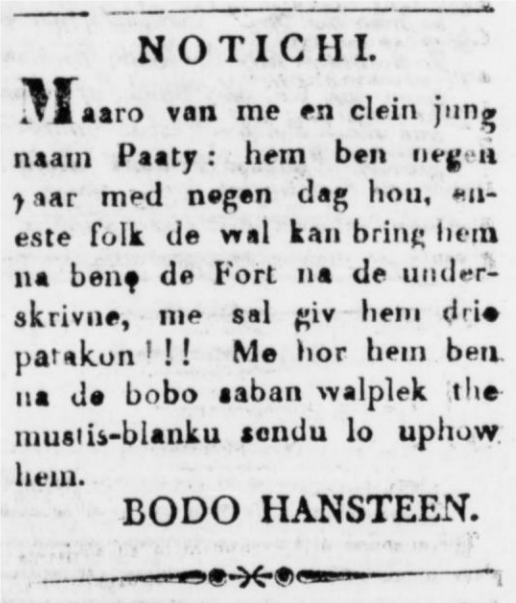
Kristoffer Friis Boegh, Peter Bakker (both Aarhus University), Rasmus Christensen (University of Copenhagen) and I (Meertens Institute, Amsterdam) have just published seven eighteenth- and early nineteenth-century Virgin Islands Dutch Creole texts. Most of them were found by Rasmus in newspapers from the former Danish Antilles (Boegh et al. 2023). One of the published texts deserves extra attention: the runaway ad by Bodo Hansteen (1817). It is a call to bring a fled enslaved person back to Hansteen.
Escaped from me a little boy/young person named Paaty. He/she is nine years and nine days old. Any people who can bring him into the fort [i.e., Fort Christian in Charlotte Amalie, St. Thomas] with the undersigned, I will give him three patakons (dollars)!! I hear he is in the high grasslands where the white mestizos keep him. (Boegh et al. 2023)
We find these advertisements in all kinds of Caribbean newspapers at the end of the eighteenth and beginning of the nineteenth century. A quick look in Dutch-language newspapers yields similar Surinamese advertisements and Roland de Bonth already referred to it in his treatment of the Dutch word Absenteer (De Bonth 2021). Enrique Corneiro (2018) published an enormous amount of ‘runaway slave adds’ that appeared in the newspapers in the Danish Antilles (now US Virgin Islands). Some of them indicate that the escapee speaks ‘Dutch Creole’, but the advertisements are generally in English. Hansteen’s Creole advertisement does not appear in this book.
What particularly interests me about Hansteen’s advertisement is that it was written in Dutch Creole in an English-language newspaper. English emerged in the northern Caribbean, especially after independence of the United States, replacing Dutch and Virgin Islands Dutch Creole as the main spoken languages in the Danish Antilles. For example, Hansteen’s text shows that it is still useful to use Virgin Islands Dutch Creole in an advertisement. However, which audience did he have in mind? Are freed people or enslaved ones who can read Creole his audience, the target group to capture escapees? Does he prefer to use Creole because he himself does not have a good command of English?
We can indicate the period of origin of Creole languages more or less precisely and the languages related to Dutch in the Caribbean can only have emerged after language contact in the seventeenth century between Dutch-speaking planters and enslaved people. Texts in and about these languages from this period not only present us insight into the process of emergence of the language, but also in how its use developed. Online databases such as those of the Dutch National Archives or the Danish State Archives can bring us close to the first stages of Creole languages by recognizing the snippets of Creole in the pieces, as Mark Ponte has done now in the case of Berbice Dutch Creole.
Sources
Langen, D.H. van. 1803, 7 maart. Letter to Elisabeth de Loos. Rio Berbice. 3 p. https://t.co/5RbKL19Xmg
Boegh, Kristoffer Friis, Peter Bakker, Cefas van Rossem & Rasmus Christensen. 2023. “Seven newly discovered 18th and 19th century Virgin Islands Dutch Creole Texts”, in: Faraclas, N., R. Severing, E. Echteld, S. Delgado & W. Rutgers (eds) Caribbean Convivialities and Caribbean Sciences: Inclusive Approaches tot he Study of the Languages, Literatures and Cultures of the Dutch Caribbean and Beyond. Willemstad: University of Curaçao. 93-116.
Corneiro. Enrique. 2018. Runaway Virgins, Danish West Indian slave ads, 1770-1848. Richmond: Triple E Enterprise. 112 p.
Jacobs, Bart, & Mikael Parkvall. 2020. ‘Skepi Dutch Creole, The Youd Papers’. In: Journal for Pidgin and Creole Languages, 35, 1, 360-380.
Jacobs. Bart & Mikael Parkvall. 2023. ‘Skepi Creole Dutch, The Rodschied Papers’. In: Journal for Pidgin and Creole Languages. Published online, 13 Juli 2023.
Kouwenberg, Silvia. 1994. A Grammar of Berbice Dutch Creole. Berlin, New York: Mouton de Gruyter.
Robertson, Ian E. 1989. 1989. ‘A comparative wordlist of Berbice Dutch, Skepi Dutch and Negerhollands’. In: Tijdschrift voor Nederlandse Taal- en Letterkunde 105. p. 3-21
Robertson, Ian E. 1994. ‘Berbiciaanse woorde’. In: T. Veenstra (ed), Amsterdam Creole Studies XI, 67-74.
Smith, Norval S.H., Ian E. Robertson & Kay Williamson. 1987. ‘The Ijo element in Berbice Dutch’. In: Language in Society 16, 49-90.
A few moments ago I mentioned Aarhus the beating heart of the study of Virgin Islands Dutch Creole in Europe. Well… another example is the following article which was published on September 27, 2023. It presents the live of Mrs. Alice Stevens, the last native speaker of Virgin Islands Dutch Creole, and her role in the study of the language. An interesting read with links to further study or information about the language.






 die creol taal
Special issue of Scandinavian Studies in Language!
Only a few days ago editors Kristoffer Friis Boegh (University of Utrecht, the Netherlands, University of Aarhus, Danmark) and Peter Bakker (University of Aarhus) published the special issue of Scandinavian Studies in Language: Vol. 15 No. 2 (2024): Special issue: Pidgins, creoles, and language contact in Danish and Dutch colonial contexts.
No less than five articles are dedicated to aspects of Virgin Islands Dutch Creole, its history and metalinguistic matters:
Bøegh, Kristoffer Friis & Peter Bakker. 2024, Decmber 20. ‘Pidgins, creoles, and language contact in Danish and Dutch colonial contexts, a presentation of the special issue.’In: Bøegh, Kristoffer Friis & Peter Bakker (eds). 2024. Pidgins, creoles, and language contact in Danish and Dutch colonial contexts. Special issue of Scandinavian Studies in Language. Vol. 15, No. 2. 2024. Pp. 1-15. > Pidgins, creoles, and language contact in Danish and Dutch colonial contexts: A presentation of the special issue | Scandinavian Studies in Language
Rossem, Cefas van. 2024. ‘The suspicion confirmed, J.P.B. de Josselin de Jong’s 1923 linguistic fieldwork in St. Thomas and St. John on Virgin Islands Dutch Creole’ In: Bøegh, Kristoffer Friis & Peter Bakker (eds.). 2024, December 20. Pidgins, creoles, and language contact in Danish and Dutch colonial contexts. Special issue of Scandinavian Studies in Language. Vol. 15, No. 2. Pp. 16-55. > The suspicion confirmed: J.P.B. de Josselin de Jong’s 1923 linguistic fieldwork in St. Thomas and St. John on Virgin Islands Dutch Creole | Scandinavian Studies in Language
Stein, Peter. 2024. ‘Grammaticography of Virgin Islands Dutch Creole (Negerhollands) from the Danish West Indies, Oldendorp and Magens’ In: Bøegh, Kristoffer Friis & Peter Bakker (eds.). 2024, December 20. Pidgins, creoles, and language contact in Danish and Dutch colonial contexts. Special issue of Scandinavian Studies in Language. Vol. 15, No. 2. Pp. 180-197. > Grammaticography of Virgin Islands Dutch Creole (Negerhollands) from the Danish West Indies: Oldendorp and Magens | Scandinavian Studies in Language
Appel, Charlotte, Peter Bakker & Joost Robbe. 2024. ‘Initiating reading in Creole.’ In: Bøegh, Kristoffer Friis & Peter Bakker (eds.). 2024, December 20. Pidgins, creoles, and language contact in Danish and Dutch colonial contexts. Special issue of Scandinavian Studies in Language. Vol. 15, No. 2. Pp. 198-239. > Initiating reading in Creole: Contents and contexts of primers in the Danish West Indies, 1770–1825 | Scandinavian Studies in Language
Robbe, Joost & Peter Bakker. 2024. ‘A grammatical and graphematic comparison of five Creole primers from the Danish West Indies (1770-1825), with a preliminary phonemic inventory.’In: Bøegh, Kristoffer Friis & Peter Bakker (eds.). 2024, December 20. Pidgins, creoles, and language contact in Danish and Dutch colonial contexts. Special issue of Scandinavian Studies in Language. Vol. 15, No. 2. Pp. 240-288. > A grammatical and graphematic comparison of five Creole primers from the Danish West Indies (1770–1825), with a preliminary phonemic inventory | Scandinavian Studies in Language
Please visit this link: https://tidsskrift.dk/sss/issue/view/11790 to also see which other articles were published in this digital volume!
Hopefully I will soon have the possibility to get into these articles.
Leave a comment
Posted in Announcements and reviews, Danish sources, De Josselin de Jong, Magens, metalinguistic comments, Moravian Archives
Tagged caribbean, Dutch, history, language, travel