
In 1986 Thomas Stolz (University Bremen) published his thorough study of Virgin Islands Dutch Creole. In German he presents an extensive description of VIDC grammar. At the moment it is available as download for members of ResearchGate.net.

Archives, online available
History of Moravian Mission
History of Danish Antilles
- 12 Court Cases from the Danish West Indies 1822-1844 – Unesco Teaching Materials
- 200 Years in Paradise. Genealogical site with information about history of US Virgin Islands
- Deahl, Tim. Development of Dutch relations with the Danish island St. Thomas. MA thesis University Leyden, 2012, Dutch
- Donella II, Joseph A. Like other peoples children: the Danish West Indies Lutheran Mission (…). Madison: 2007.
- Knox, John P. A Historical Account of St. Thomas
- Sebro, L. Mellem afrikaner og kreol, Etnisk identitet og social navigation i Dansk Vestindien 1730-1770, Lund: 2010
- Statens Arkiver: The West-Indies – Sources of history
- Trans-Atlantic Slave Trade
- Transatlantic Slave Trade – Denmark – Unesco Teaching Materials 1
- VI Now about language
- Westergaard, The Danish West Indies Under Company Rule 1671-1754, New York: 1917
- Westergaard, Waldemar. The Danish West Indies Under Company Rule 1671-1754 Facsimile full text
Philology
Recent comments
Historical Dutch letters
Dictionaries online
Recent publications
DieCreolTaal in Blogs
Categories
- Alice Stevens (1)
- Announcements and reviews (43)
- Clarin-NEHOL Corpus (2)
- Danish sources (9)
- De Josselin de Jong (289)
- Dictionaries (1)
- Dutch related contact languages (6)
- Hesseling (4)
- Historical corpora (12)
- Delpher (2)
- KITLV (279)
- Linguistics (4)
- Magens (2)
- Manuscripts (298)
- Meetings (3)
- metalinguistic comments (282)
- Moravian Archives (8)
- Nelson (3)
- On the Internet (18)
- Podcast (15)
- Presentations (2)
- Uncategorized (13)
Archives
- November 2025
- May 2025
- December 2024
- September 2024
- August 2024
- June 2024
- November 2023
- October 2023
- September 2023
- August 2023
- July 2023
- June 2023
- May 2023
- April 2023
- March 2023
- February 2023
- January 2023
- December 2022
- November 2022
- May 2022
- March 2022
- February 2022
- December 2021
- November 2021
- October 2021
- August 2021
- July 2021
- June 2021
- May 2021
- April 2021
- October 2020
- May 2020
- August 2019
- February 2019
- September 2018
- August 2018
- December 2017
- October 2017
- June 2017
- May 2017
- March 2017
- February 2017
- January 2017
- December 2016
- October 2016
- September 2016
- August 2016
- June 2016
- May 2016
- April 2016
- February 2016
- December 2015
- November 2015
- October 2015
- July 2015
- June 2015
- April 2015
- March 2015
- February 2015
- January 2015
- November 2014
- August 2014
- July 2014
- June 2014
- May 2014
- April 2014
- February 2014
- January 2014
- December 2013
- November 2013


 die creol taal

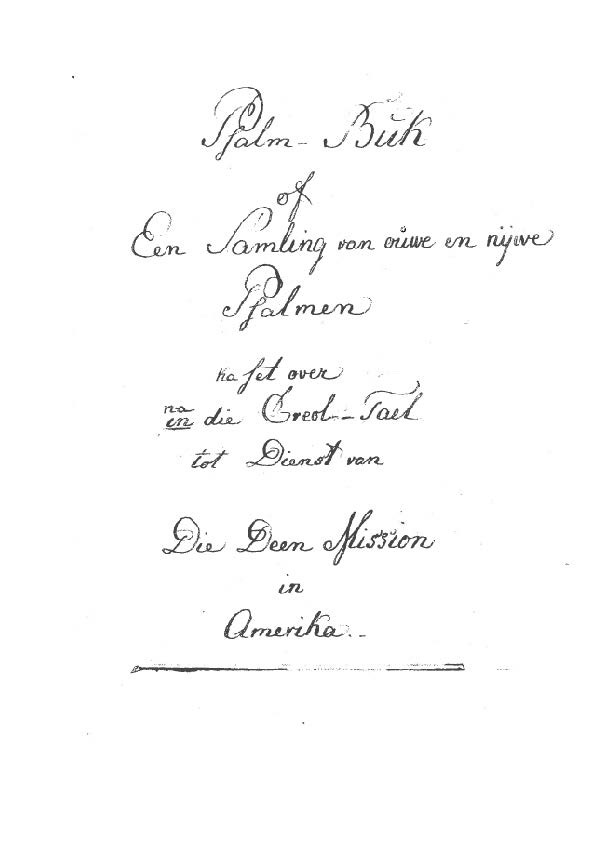
Creol Psalm Buk 1834 digitally available
For his work on the VI Dutch Creole Database and Die Creol Taal 1996, Hein van der Voort studied many, if not all, available Creole texts by Danish translators. In our Bibliography he added several remarks with regard to the printing history of these sources. The information about Creol Psalm-Buk, of een Vergaedring van Oûwe en nywe Psalmen na Creol-Tael. (Copenhagen: 1834) gives interesting information which is comparable to the metalinguistic comments I published in my former post:
‘Schuchardt (1914:124) also mentions this (1834, cvr) edition. This must then be the fourth edition or the fifth (when Brandt 1799 is included) of 1770. This is an exact copy of 1827. Note that likewise, Prætorius’ catechism-and-textbook of 1834 is identical to the one from 1827. Furthermore, both works from 1827, then printed at C. Græbe, were reprinted in 1834 at P.T. Brünnich, and each in an issue of 1000 copies (as appears from an account of 10 November 1834 in RA, Koloniernes Centralbestyrelse, Kolonialkontoret, Gruppesager II. 922 Salmebogssagen).’ (Bibliography p. 19, November 6, 2015)
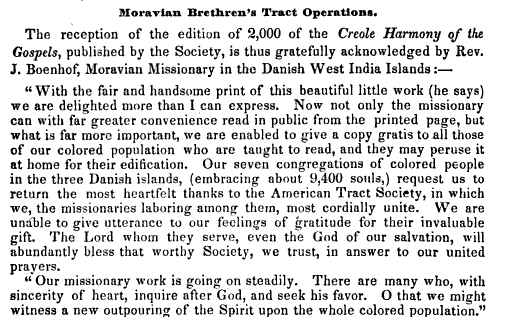
Like the Gospel Harmony which was distributed in 1834 in 2000 copies, this hymn booklet was distributed in 1000 copies. This seems to me a huge number, when we keep in mind that Dutch Creole is already more and more replace by English (Creole) in the early nineteenth century.
A comparison of four versions of the hymn, O Planterman, (Wold 1770, Kingo 1770, Praetorius 1823 and Creol Psalm-Buk 1834) shows that there are, although minor and only orthographical, differences between the latter two.
The Creol Psalm-Buk is available at the following places:
Babel Hathitrust
Google Books
Leave a comment
Posted in Danish sources, On the Internet
Tagged comparison of texts, Hymn books, metalinguistic comments