In 1739, during the visit of the Count Nicolaus von Zinzendorff, two letters were written by enslaved members of the community of the Moravian Brethren. In the first letter, which was addressed to the Danish king, a group of enslaved people complained about their position in the Christian community. Despite being baptized, they were looked down upon by the colonists.
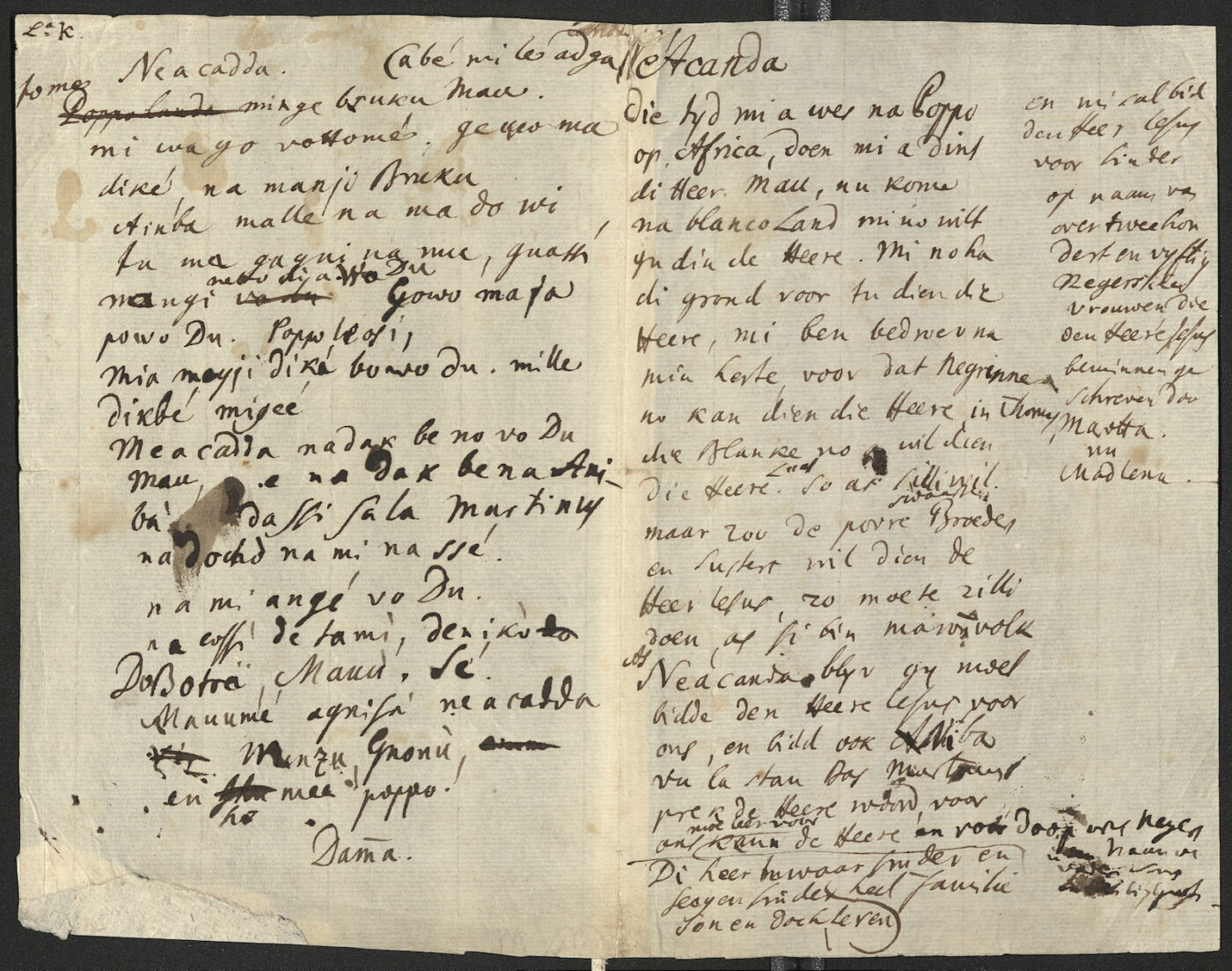
The second letter was written by Damma, also known as Marotta and Madlena. It consisted of two texts: one of them was written in an African language that was unknown to us until recently and the other was a translation of it into Virgin Islands Dutch Creole. In 1742 these letters were published and these were probably the first examples of texts in which enslaved people expressed their emotions in non-European languages.
The African letter of Damma remained a mystery and several scholars tried to unravel parts and pieces, using the Creole translation. Indications of possible West African languages were presented and published,but unfortunately, an undisputed language variant was lacking.
Version 1 of Damma’s letter. Courtesy of the Unitätsarchiv der Evangelischen Brüder-Unität, R.15.B.a.03.61_a-b
Two years ago Katharine Gerbner, assistent professor History of Religion at the University of Minnesota, formed a research group in which she, five linguists specialized in West African languages and Virgin Islands Dutch Creole and a historian specialized in the history of female enslaved in the Danish Westindies, worked together to translate the text, but also to portrait the writer of it.
The website which was constructed looks beautiful and consists of several related essays. The African letter is translated and Damma turned into a real person.
In a St. Thomas catechism manuscript from the period 1842-1847, pastor H. Wied has written on the title page ‘In the 1840s, the Creole language disappeared in the West Indian islands and was replaced by English.’ But that didn’t happen. In 1871 and 188/1887, publications by the American scholar Addison Van Name and the Danish physician Erik Pontoppidan were published, still containing some remnants of Virgin Islands Dutch Creole, or Carriols as we call the language nowadays.
In 1883, the Austrian Hugo Schuchardt, perhaps the first linguist we can call a creolist, received a letter from the Virgin Islands physician Anthon Magens. It was a response to a request for a fragment in the Dutch Creole as spoken by the population of St. Thomas. Only in 1914 this letter, filled with words unknown from eighteenth-century sources, was published in the Tijdschrift voor Nederlandsche Taal- en Letterkunde. On May 28, 2022, I published an episode about this letter, ‘The Letter of Anthon Magens’ in my podcast Di hou creol. (10. De brief van Anthon Magens)
The letter that Schuchardt received from Magens in 1883 turned out to be the first comprehensive account of the Dutch Creole as spoken by the local population of the Danish Antilles, St. Thomas, St. John, and St. Croix.
Carriols as sources dating back to shortly after the language’s emergence. In 1672, the language did not yet exist, it is first referred to in 1736, and since 1739, there have been written texts in this language. However, the vast majority of these texts consisted of translations of missionary texts by German and Danish missionaries. In my research from 2017, I attempted to find clues about the actually spoken Creole in these texts.
Anthon Magens, a distant relative of Jochum Melchior Magens, who published a grammar of the Virgin Islands Dutch Creole in 1770, stated in a letter to Schuchardt that he recorded the daily language with the help of his maid. After a description of a day in the Creole, with many words for vegetables for example and a series of proverbs, follows a so-called ‘pistarkel’, a spectacle that the doctor would have experienced in the streets of Charlotte Amalia. Schuchardt’s publication is in German, but the Creole has been translated into Dutch by Dirk Christiaan Hesseling, who dedicated a substantial publication to the language in 1905.
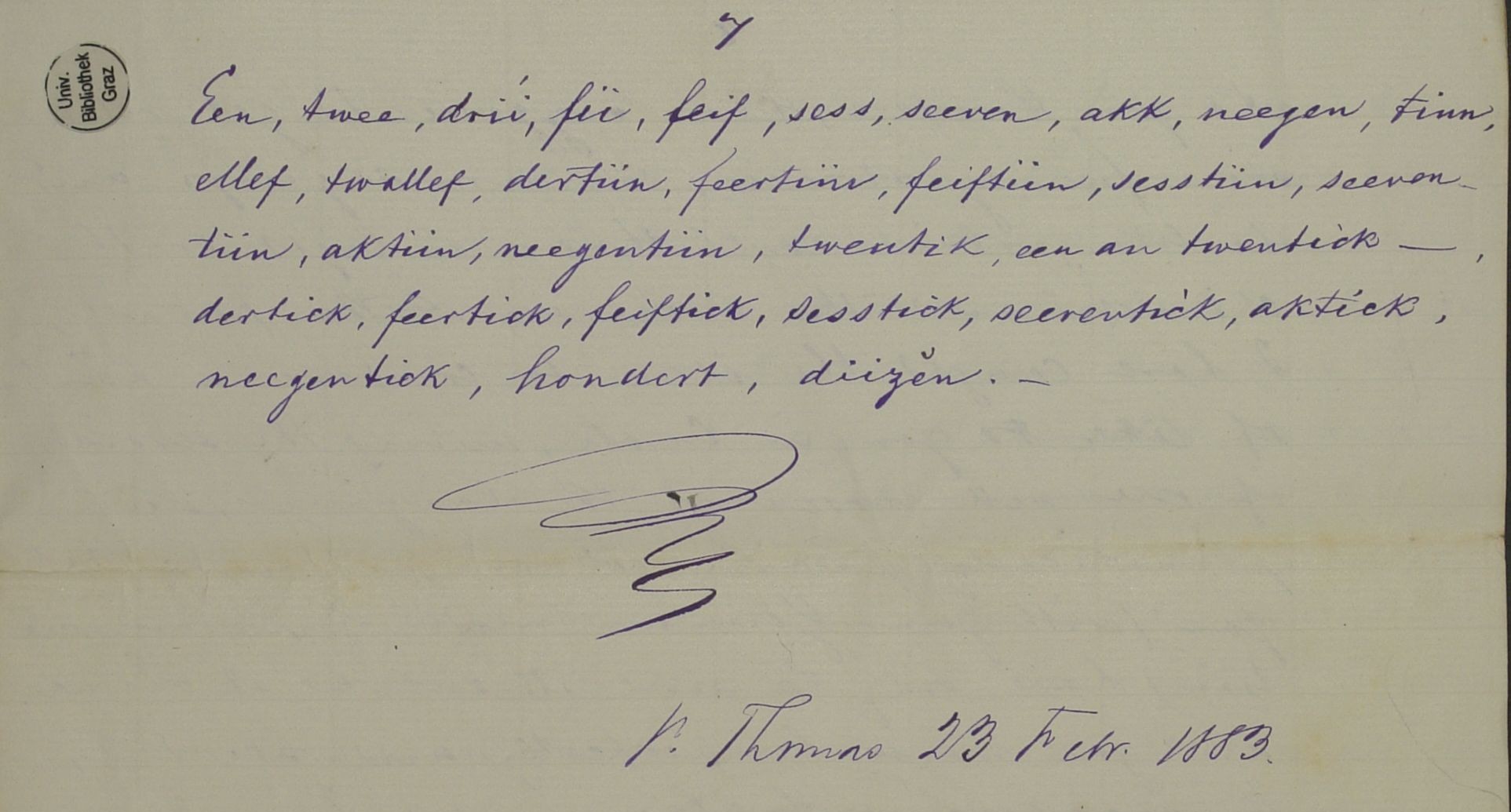
The complete letter is preserved in the archive of Hugo Schuchardt in Graz, and for instance, Peter Bakker, who is currently leading a significant research group on the Virgin Islands Dutch Creole in Aarhus, and his student Sebastian Dyhr, had studied the letter some years ago. Through Sarah Melker, the archivist of Schuchardt’s archive, I received photos of the letter. There is hardly any difference between the letter and its publication in 1914, except for one part on page 7: the numerals.
Why wasn’t this part of the letter published by Schuchardt? Didn’t he consider it of importance? I think it is a valuable addition to the rest of the Creole texts.
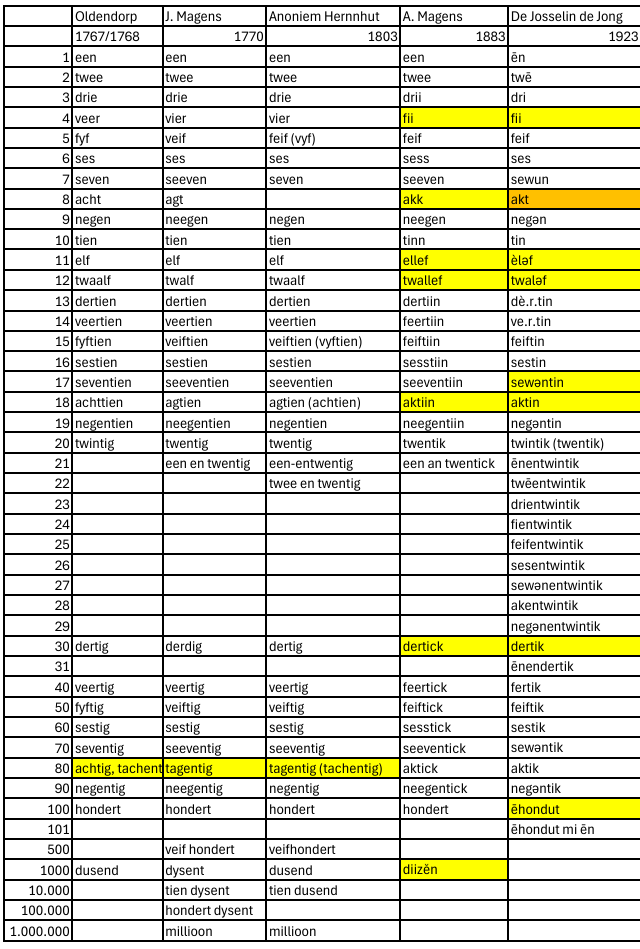
Already in 1767/1768 Oldendorp published numerals in his dictionary (Stein 1996). In Magens’s 1770 Grammar the list is even longer and an anonymous Moravian Grammar copied Magens’s list with some changes. These list were probably necessary for the translations of the missionary texts and look quite Dutchlike.
The numerals as used in the wordlists and texts by De Josselin de Jong (1926), Nelson (1936) and Sabino (2012) look not as bookish as the above mentioned. Of course these were collected during field work in conversations. It is nice to see the numerals from the Magens-letter do show not only Dutchlike numerals, but also the more Creolelike ones which are similar to those which were collected by De Josselin de Jong, Nelson and Sabino.
In this figure you will find all numerals from the above mentioned publications. De Josselin de Jong (1926) mentions his informants, however it is unclear who submitted these numerals and whether these were from St. Thomas or St. John. Nelson (1936) collected two sets of numerals, by Henrietta Francis (Fredriksted, St. Croix) and Rebecca Francis (St. Thomas). Robin Sabino learned the language from Alice Stevens in the 1980s. I used her dictionary from Sabino (2012).
The yellow words are remarkable. See for instance the words for 80. In 1767/68 both achtig en tachentig are used. Tachtig is as in Dutch tachtig,of which the t may be explained from Old Saxon antathoda. In the words for 80 which were recorded during fieldwork, no initial /t/ is found.
We can also see the final /g/ changes during time into /k/ (achtig (80) -> aktik) or it disappears, like in other numerals: dertig (30) -> dertik -> derti).
Henrietta Francis (St. Croix, 1936) used some forms which point to a a kind of twenty-based system, in which the word enskeling is used for 20, twe skeling for 40, dri skeling for 60 and forskeling for 80. In historical Dutch schelling indicates a 20th part of a pound (see Woordenboek der Nederlandse Taal). The word en patakon, she used for 100 is also interesting. It was used in historical Dutch, but is etymologically related to Iberian languages.
I haven’t checked the use of numerals in the eighteenth century missionary texts, like the Old Testament or the Gospel Harmonies yet. However, it is already clear that the list from the Magens-letter is an interesting link between written Carriols of the eighteenth century and the spoken variety of the twentieth century.
A few moments ago I mentioned Aarhus the beating heart of the study of Virgin Islands Dutch Creole in Europe. Well… another example is the following article which was published on September 27, 2023. It presents the live of Mrs. Alice Stevens, the last native speaker of Virgin Islands Dutch Creole, and her role in the study of the language. An interesting read with links to further study or information about the language.
At the moment the study of Virgin Islands Dutch Creole gets boosts from both sides of the Atlantic. On the US Virgin Islands, Gylchris and Gilbert Sprauve (in coöperation with Peter Stein and me) work on a book with dialogues in Dutch Creole. More about it in near future.
In Europe, at the moment the University of Aarhus is the beating heart. Historian Rasmus Christensen (University of Copenhagen) and linguist/creolist Peter Bakker (Aarhus University) have discovered seven eighteenth and nineteenth century short texts which add interesting information to the history of Virgin Islands Dutch Creole, and especially to the use of the language in newspapers. Recently an article about these texts was published by Kristoffer Friis Boegh (Aarhus University), Peter Bakker (Aarhus University), Rasmus Christensen (University of Copenhagen) and me.
All texts are interesting, but the following is perhaps the most moving. In Enrique Corneiro’s 2018 book Runaway Virgins, Danish West Indian slave adds, several advertisements contain information about the enslaved people being speakers of Dutch Creole. However none of the ads is written in Creole. Rasmus Christensen found the following text (Hansteen, B. (1817, January 23). ‘Notichi’. St. Thomæ Tidende. http://hdl.handle.net/109.3.1/uuid:05863d96-89b4-4272-8dd1-7d91bf06385d)
Escaped from me a small youngster/boy named Paaty. He/she is nine years and nine days old. Any person/people who are able to bring him/her inside the Fort [i.e., Fort Christian in Charlotte Amalie, St. Thomas] to the undersigned, I will give him/her three dollars!! I have heard that he/she is in the higher grasslands where the mestizo-whites are keeping him/her.
(Translation by Boegh et al. 2023)
Hopefully the article will soon be widely available!
Boegh, Kristoffer Friis, Peter Bakker, Cefas van Rossem & Rasmus Christensen. 2023. “Seven newly discovered 18th and 19th century Virgin Islands Dutch Creole Texts”, in: Faraclas, N., R. Severing, E. Echteld, S. Delgado & W. Rutgers (eds) Caribbean Convivialities and Caribbean Sciences: Inclusive Approaches tot he Study of the Languages, Literatures and Cultures of the Dutch Caribbean and Beyond. Willemstad: University of Curaçao. pp. 93-116.
Today Kristoffer Friis Bøegh has send me the following news:
“The feature film “Empire” is nominated for the 2023 Nordic Council Film Prize.
St. Croix, the Danish West Indies, 1848. Anna Heegaard and Petrine are close friends. Although both are women of colour, their living conditions are very different – Anna is free and owns the enslaved Petrine. Anna shares her life with Danish Governor General Peter von Scholten at her country house, where she manages the home, her fortune, and her beloved and trusted housekeeper Petrine. Things are seemingly fine until rumours of a rebellion begin to swirl. Which side are Anna and Petrine really on, and is it the same one?”
On July 3rd the US Virgin Islands celebrates emancipation of the enslaved took place o175 years ago. Please visit this site to know more about this beautiful day.
During the period of slavery most of the enslaved used a Dutch related Creole language which emerged at the end of the seventeenth and the beginning of the eighteenth century on the Danish Westindies, in which a large part of the colonist used Dutch as their venacular. The language was called Carriolsch, Creole and lateron in European/Dutch publications ‘Negerhollands’. From about 2013 on we use the name Virgin Islands Dutch Creole.
The language is conserved in a large number of missionary texts from the eighteenth and nineteenth century, and a lot of stories, sentences and words which were noted in early twentieth century interviews.
From the end of the 1960s until 1987 several last native speakers helped linguists to study and learn the language as it was actually spoken.
The most remarkable Virgin Islands Dutch Creole text related to slavery, which was expressed by an enslaved man is noted in 1788. The following farewell song invites the listener to enter the thoughts of a desperate enslaved one:
Only a few days ago Peter Bakker (Aarhus University) published his review of my dissertation The Virgin Islands Dutch Creole Textual Heritage: Philological Perspectives on Authenticity and Audience Design (2017) (and my defence) on Lingoblog.dk. You can find the text here.
Next week, on wednesday December 20, I will defend my PhD-thesis The Virgin Islands Dutch Creole Textual Heritage: Philological Perspectives on Authenticity and Audience Design. The defence will take place at the Radboud University Nijmegen, The Netherlands. The thesis will appear as no 477 in the LOT-dissertation series. An Open Source version will be available from December 20th on. I will publish the link on this website.
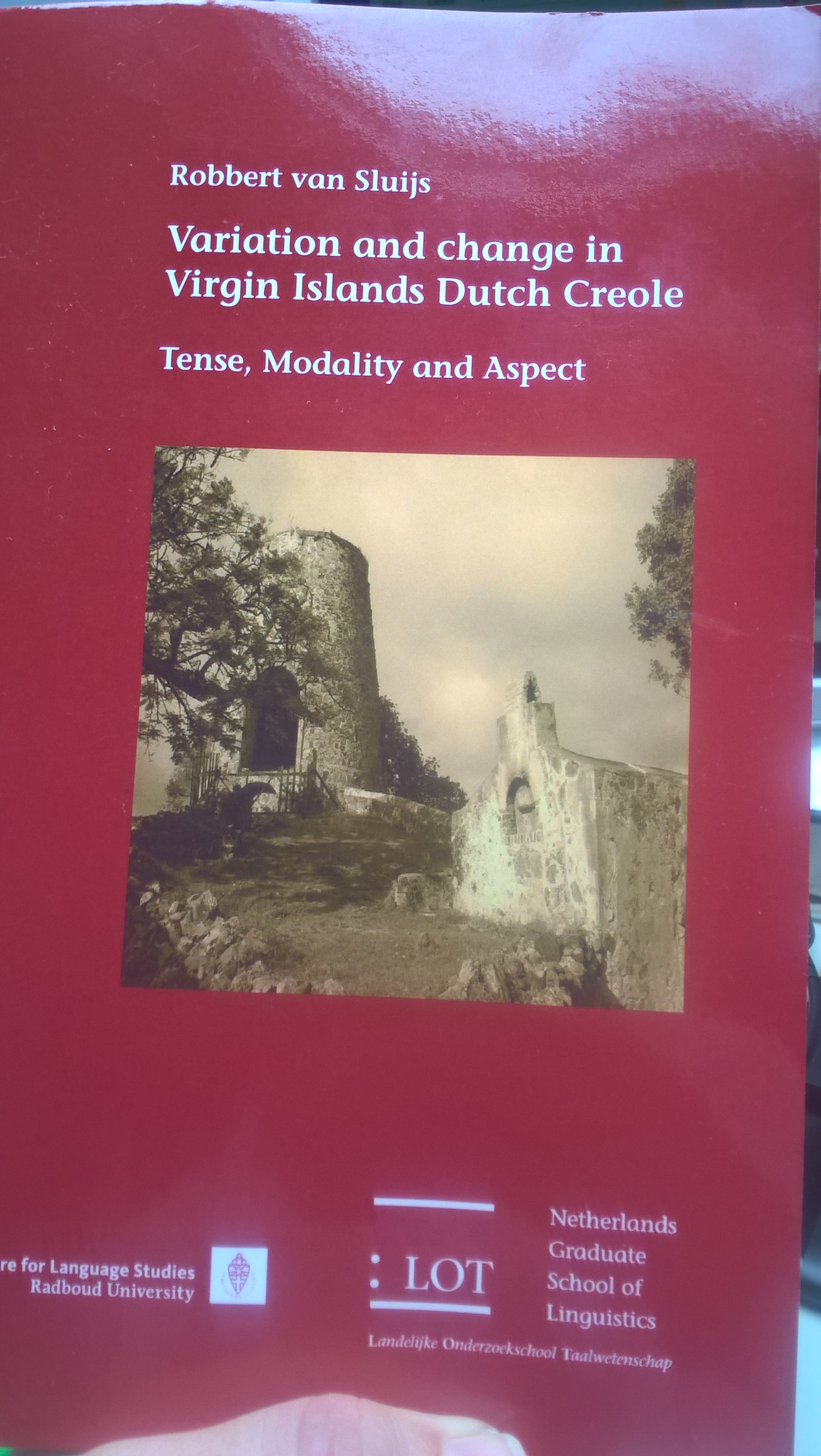
Next Thursday, May 11th 2017, my colleague Robbert van Sluijs will defend his doctoral dissertation Variation and change in Virgin Islands Dutch Creole, Tense, Modality and Aspect.
In seven extensive chapters, Van Sluijs focuses on the Virgin Islands Dutch Creole TMA-system, for instance the use of a, le/lo and ka, especially in sources which are available in the Clarin-NEHOL-corpus.
The interesting book from this creolist of Radboud University Nijmegen, The Netherlands, is published by the Netherlands Graduate School of Linguistics, LOT 453. An OpenSource-version will be available in near future.





 die creol taal